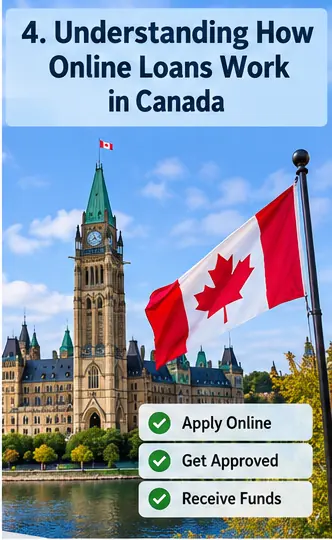
Understanding How Online Loans Work in Canada
Digital technology has changed the way Canadians access financial products, including personal loans, lines of credit, and short-term financing. Instead of relying exclusively on in-person appointments, consumers can now research borrowing options and submit applications through online platforms. Anyone comparing Canadian online payday loans should understand how these services operate, which regulations may apply, and what responsibilities arise when a loan agreement is accepted.
What Is an Online Loan?
An online loan is a credit product that can be applied for through a website or digital application.
The term describes the application and lending process rather than a single type of financing.
Some online loans are personal instalment loans, while others are short-term payday loans. Certain financial institutions also allow existing customers to apply digitally for lines of credit.
The repayment schedule, interest charges, borrowing fees, and eligibility requirements depend on the product.
This distinction is important because two loans offered online may have substantially different costs and conditions.
What Happens After an Application Is Submitted?
When an applicant submits financial information, the lender begins an assessment.
The process may include verifying identity, confirming income, examining existing financial commitments, and checking credit history.
Some lenders use automated systems to evaluate applications according to predetermined lending criteria.
Others require staff to review information manually, particularly when documentation is incomplete or circumstances are unusual.
The lender may approve the request, decline it, or ask for more information.
Approval can also be conditional on completing additional verification steps.
A digital application does not remove the need for responsible lending practices or accurate borrower information.
How Borrowed Funds Are Delivered
Once a loan agreement has been accepted and all requirements have been satisfied, lenders generally provide the funds through an approved payment method.
Depending on the institution and product, funds may be deposited directly into a bank account or transferred electronically.
The timing varies according to lender procedures, payment networks, banking hours, and verification requirements.
An advertisement suggesting rapid funding should not be treated as a guarantee that the money will become available immediately.
Consumers should confirm expected deposit arrangements directly with the lender.
The Difference Between Interest and Borrowing Fees
Personal instalment loans often charge interest based on the outstanding balance.
The applicable rate and repayment period influence the total cost.
For example, an instalment loan with a longer repayment period may have smaller individual payments but potentially higher total interest charges.
Payday loans typically operate differently. They generally charge a fixed amount for each $100 borrowed, subject to applicable legal limits.
In provinces where payday loan regulation applies, the current maximum charge is $14 per $100 borrowed.
These different pricing systems make it essential to compare total repayment amounts rather than simply examining advertised payment sizes.
Provincial Regulations and Consumer Rights
Canada does not have a single uniform set of consumer lending rules covering every product in every jurisdiction.
Federal law establishes certain requirements, while provinces and territories may regulate lending businesses and consumer agreements.
For example, payday lending in Alberta is governed by provincial rules covering lender licensing and other business practices.
Ontario and British Columbia also have specific consumer protections for payday borrowers.
Requirements can differ depending on the province where the consumer resides and the type of loan offered.
Borrowers should understand the protections relevant to their particular agreement.
Why Credit History May Matter
Credit history helps many lenders evaluate the likelihood that an applicant will repay borrowed funds.
A credit report can contain information about previous borrowing, payment records, credit accounts, and outstanding obligations.
Some online lenders place greater emphasis on current income or banking information, while others conduct more traditional credit assessments.
Having a lower credit score does not automatically determine every lending decision, but it may limit available products or affect offered terms.
Borrowers should avoid advertisements suggesting that every applicant will qualify.
Making Sense of the Loan Agreement
Before accepting any financing, examine the complete agreement.
Look for the principal amount, total cost of borrowing, payment schedule, late-payment conditions, and any optional services.
If the lender proposes automatic withdrawals, confirm the payment dates and amounts.
Keep a copy of all signed documents and electronic communications.
Online borrowing offers convenience, but the underlying financial commitment remains the same as with a traditional loan.
Understanding the product, comparing its cost, and assessing repayment affordability are essential regardless of how the application is submitted.
HAVE QUESTIONS FOR THE BLOG?